
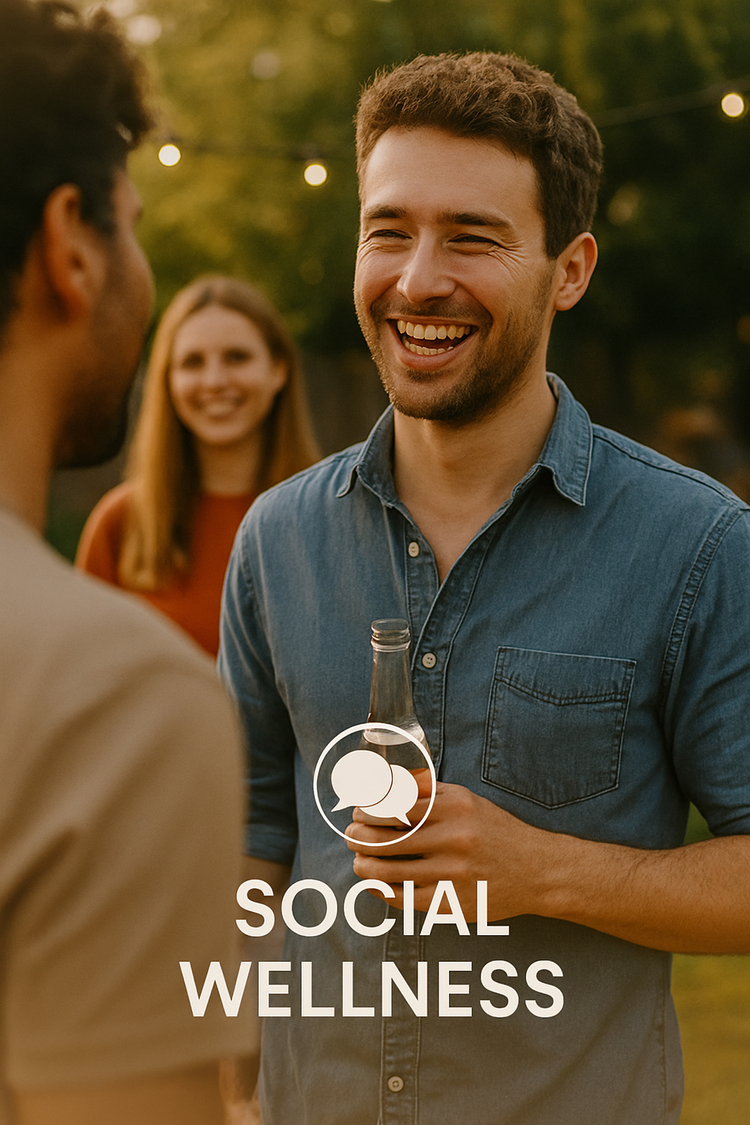
Social Wellness
In 2010, Julianne Holt-Lunstad and Timothy Smith at Brigham Young University, with J. Bradley Layton at UNC Chapel Hill, pooled 148 studies covering 308,849 people, followed for an average of seven and a half years. People with stronger social relationships had about 50% greater odds of surviving the follow-up period than people with weaker ones. The effect was comparable in size to quitting smoking, and larger than the effects of obesity or physical inactivity.
What it covers
Social wellness is the quality of your relationships and where you belong. It has little to do with popularity or the size of your calendar. It rests on four things.
Close ties
People who would show up in a crisis.
Belonging
A place in a neighborhood or a community.
Reciprocity
Giving and receiving help, down to small favors.
Fit
The amount and kind of contact that suits your temperament.
What I saw at the bedside
Patients with a spouse, partner, or close friend checking in every day often healed faster. They kept up with their medications, showed up for follow-ups, and stayed engaged in rehabilitation. Someone drove them to appointments and sat at the bedside. Patients without that support often had slower, lonelier recoveries.
I scored in the 96th percentile for introversion. For me, networking usually means one good conversation and a nap. A close friend introduced me to Café Driade in Chapel Hill, her favorite place. Some of my best conversations have happened on its patio, tucked into the trees, with birds overhead and companionable silences.
What the research measures
At UCLA, Naomi Eisenberger and Matthew Lieberman, working with Kipling Williams of Macquarie University in Sydney, scanned 13 volunteers while they played Cyberball, a ball-tossing video game they believed they were playing with two other people. Partway through, the other two stopped throwing them the ball. During that exclusion, activity rose in the dorsal anterior cingulate cortex, a region also active in physical pain, and the volunteers who reported the most distress showed the most activity there. The study appeared in Science in 2003. How much social and physical pain share the same circuitry has been debated since.
Listen and read
Podcast. Wellness, Rewired, Episode 5: The Social Dimension
Essay. Why Friendship Might Be the Most Powerful Health Habit
The Well-IQ assessment is free and takes about 15 minutes. It scores Social alongside the other eight dimensions.
Educational content, not medical advice.